The day I arrived in Basel happened to be the paper waste recycling day in my area. The scene of the stacks of newspapers, magazines, and paper piled up neatly along the roadside neatly shocked me. Before I came, I had learnt how restrictive the waste recycling system is on social media. While being faced with this almost excessive scenery of order not only made me think of environmental protection but also raised a more fundamental question: how did this order enter private living spaces? And in what way was it taken for granted? As a “newcomer” who was about to live here and would inevitably have to abide by these rules, I gradually realised that waste sorting is not just an environmental policy but a governance mechanism deeply embedded in family spaces, daily time, and physical practices.
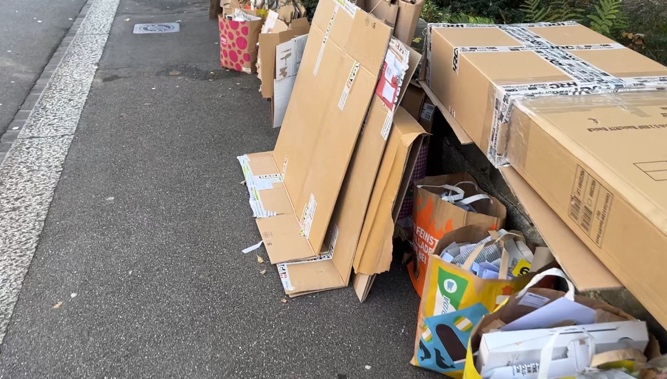
Figure 1. Paper waste awaiting recycling (photograph by the author).
The core judgement of this article is that Basel’s waste sorting system does not operate simply through coercion, but rather, by using the legitimacy discourse of environmental protection and sustainable development, it transforms family spaces into part of the system’s operation, making individuals willingly take on the spatial, labour, and time costs required by the system. Meanwhile, I believe that this governance mechanism structurally replicates a colonial logic. I am specifically referring to a governance structure that legitimises spatial encroachment, resource transfer, and subject discipline through discourse.
Spatial encroachment and resource transfer in the waste sorting system
Under the current system, paper waste in each street is collected monthly. The night before collection day, the streets are filled with neatly bundled newspapers, cardboard boxes, and wastepaper. This scene demonstrates a highly internalised cooperation: to avoid excessively occupying household space and to practise environmental protection, residents need to carefully sort, classify, and pack their waste.
However, this seemingly voluntary behaviour implies that a portion of household space is institutionally requisitioned as a temporary waste storage site. Due to the fixed collection rhythm, the temporariness has been forced into a constant process of deferring, which makes it transform as permanence while disguising as temporariness. Waste is no longer merely an object that is waiting to be discarded but a nexus that absorbs time and space. On a larger spatiotemporal scale, the government does not need to build or lease massive storage spaces and hire workers, for space and time have been distributed into countless households.
Considering the need to reduce occupation of household space and ease of moving, residents completed the primary sorting and organisation, which became an indispensable part of the system’s operation, yet the work remained unrecognised.
Furthermore, this system involves not only space, time and labour but also the resources. Product packaging is paid for by consumers and should rightfully belong to them as private property. However, once removed from the commodity system, it is quickly redefined as “worthless waste”. This “worthlessness” applies only to residents, not to the paper recycling system. As a reusable resource, the current system offers consumers no possibility of selling it. The phrase “free recycling” therefore deserves re-examination. It creates the image of the government sacrificing its own interests and helping residents deal with their problems free of charge. Here, a colonial-style governance logic emerges.
In Pollution Is Colonialism, Max Liboiron argues that environmentalism does not usually address colonialism and often reproduces it.(Liboiron 2021) The cases they analyse often occur in transnational contexts, manifesting as the continued appropriation of indigenous land and resources by colonisers. However, I believe this structure is not limited to international scales and can also manifest in domestic governance in more subtle forms.
In Basel’s waste sorting system, residents are constructed as subjects needing to be “saved” by the system: they are perceived as lacking the capacity to manage paper waste, thus requiring the government to solve the problem through institutional design. This premise not only obscures the fact that residents have already paid for resources but also that ownership and reuse benefits of them have already been transferred without discussion.
In this sense, the waste sorting system replicates the colonialist governance logic: spatial encroachment through environmental and sustainable discourse, resource deprivation through salvific discourse, and process voluntariness through the shaping of subjective identity. The ultimate reward for residents is not material compensation but the moral enjoyment of “contributing to environmental protection”. (Pohl and Swyngedouw 2023)
The system of environmental governance as a form of slow violence
In the preceding discussion, I argue the encroachment is dispersed across time and space, which goes completely unnoticed. It is in this sense that I believe it partially aligns with Rob Nixon’s characteristics of slow violence.
Rob Nixon defines ‘slow violence’ as a violence that occurs gradually and out of sight, a violence of delayed destruction that is dispersed across time and space, an attritional violence that is typically not viewed as violence at all. (Nixon 2013)
Of course, residents in Basel have not experienced any calamitous repercussions that Rob Nixon mentioned are playing out across a range of temporal scales. (Nixon 2013) In other words, the specific aftermath that handling ways of recycled waste will cause and ultimately the damage to the residents of a specific area is not within the scope of this discussion. However, the notion of slow violence is still instructive in this context.
I regard the aftermath in Rob Nixon’s book as invisible because it is in a state of constant deferring; my focus is on the invisibility that results from the status where very environmental governance has transformed itself into near-non-violence or even enjoyment for residents in daily life.
Therefore, I focus on how slow violence, no longer manifesting as physical hazards and environmental pollution but precisely controlled within a “nearly harmless” threshold, can function as a governance mechanism. In detail, this slow violence manifests on two levels: first, the control over the physical and spatial boundaries; and second, the discipline of the subject through temporal rhythms and moral enjoyment.
The first level of violence is the institutionalised control over the “critical state” of the body and home space. The garbage sorting system doesn’t require residents to endure visible pollution or discomfort in the long term; instead, through precise scheduling, it keeps garbage in the home at a “tolerable but not negligible” level.
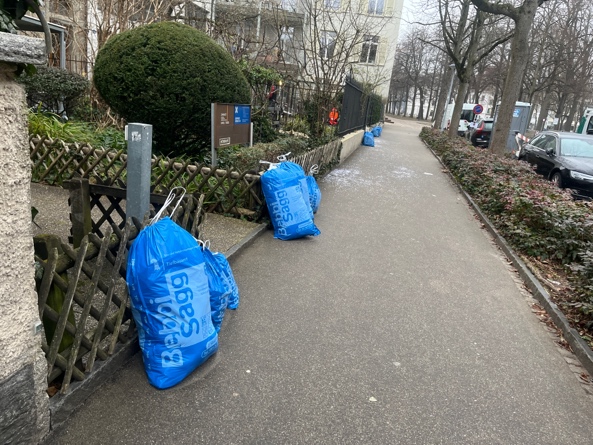
Figure 2. Non-recyclable waste awaiting collection (photograph by the author).
Take the case of paper waste collection. The monthly frequency is sufficient to prevent the significant inconvenience caused by accumulation while also forcing residents to allocate space for it within their homes. The same logic applies to non-recyclable waste: even if it contains leftovers, the three-day collection rhythm is precisely controlled before spoilage significantly affects the living environment.
This precise control of time and space keeps the home in a state of “mild pollution”, yet one that cannot be considered as a discussable problem. Violence is designed as a continuous but low-intensity presence. This harmless and invisible institutional arrangement makes violence itself unable to be identified as violence. It is this precise control of the threshold that allows the system to occupy home space, residents as unpaid labourers, and psychological attention without taking on the vicious name of violence.
This mechanism can be compared to the concept of “assimilative capacity” in environmental science. From the Streeter-Phelps equation, a moment existed when water could not purify itself, and that moment could be measured, predicted, and properly called pollution. Self-purification became known as assimilative capacity. (Streeter and Phelps 1958; Liboiron 2021)When the home space is considered a miniature ecosystem, by controlling “pollution” below an unbearable threshold, family members actively take on the function of self-purification and eco-maintenance. And any serious pollution will be identified by the subject as their own negligence rather than the structural violence of the sorting system.
Based on the above action, the second level of violence is precisely embedded in the discipline of the subject. Through temporal rhythms, repetitive practices, and moral enjoyment, individuals actively identify with and maintain the system. This makes it more difficult to be detected compared to the first type of violence.
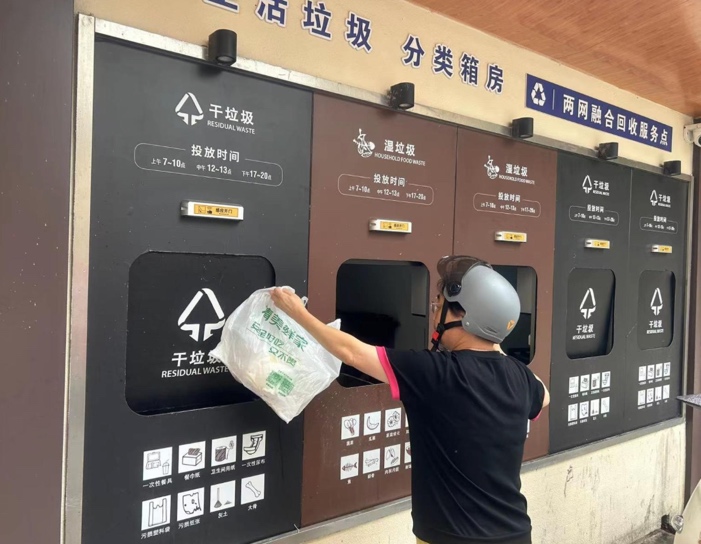
Figure 3. A waste collection station in a residential community in Shanghai (image source: online).
My personal experience during the early stages of Shanghai’s waste sorting system perfectly illustrates this process. Before the rules were officially implemented, public discussion focused primarily on the complexity and the resulting inconvenience. I, too, initially found the system cumbersome and time-consuming. However, after consistently and strictly adhering for a month, the expected discomfort did not materialise. Instead, I felt a sense of moral satisfaction, which gradually transformed into a proactive commitment to upholding the system. Take the case of my experience: when faced with residents who, for convenience, threw plastic bags containing leftovers into the leftover bin without sorting the bag into the dry waste bin, I had a distinctly negative view of them. This view stems from a judgement based on environmental ethics and social responsibility: they were increasing the burden on sorting workers and even affecting the efficiency of waste recycling for their own convenience. It was in this comparison that I gained a sense of legitimacy for my actions and further strengthened my adherence to the rules.
From my conversion, the compliance did not stem from coercive pressure but rather gradually identified with and defended order through repeated practice. Both Pascal’s analysis of the formation of faith and Louis Althusser’s concept of the ideological state apparatus highlight the crucial role of repetition in shaping the subject. (Pascal and Krailsheimer 1995; Althusser and Jameson 2001)
Compared to the first level of violence, this level is operating through enjoyment and self-affirmation. While restricting the subject’s living space and time, the system provides positive emotional feedback, making the disciplinary process itself an enjoyable experience. The public no longer views the system as an externally imposed constraint but rather internalises it as a conscious lifestyle choice.
Conclusion
This article argues that Basel’s waste sorting system is not merely an environmental measure but a governance mechanism embedded in daily life. It leverages the legitimacy of environmental protection to incorporate family space, time rhythms, and individual labour into its operation.
In this process, households are transformed into decentralised waste storage and primary processing units, while recyclable resources are transferred free of charge under the narrative of “free recycling”. This spatial encroachment and resource redistribution, masked by salvific and moral discourse, reflects a colonial-style governance logic operating routinely within the city.
The stability of the system does not rely on coercion but rather on low-intensity, imperceptible, invisible, chronic violence: on the one hand, controlling waste within a “tolerable” threshold; on the other hand, shaping subjective identity through repeated practice and moral enjoyment. Thus, order is no longer seen as a constraint but internalised as a conscious choice.
This article therefore attempts to point out that when environmental protection becomes an unquestionable moral premise, the power structure and governance methods behind it precisely need to be re-problematised.
Bibliography:
Althusser, Louis, and Fredric Jameson. 2001. Lenin and Philosophy, and Other Essays. Translated by Benjamin Robert Brewster. New York: Monthly Review Press.
Liboiron, Max. 2021. Pollution Is Colonialism. Durham London: Duke University Press.
Nixon, Rob. 2013. Slow Violence and the Environmentalism of the Poor. First Harvard University Press paperback edition. Cambridge, Massachusetts London, England: Harvard University Press.
Pascal, Blaise, and A. J. Krailsheimer. 1995. Pensées. Revised edition. London, New York: Penguin Books ; Penguin Books USA.
Pohl, Lucas, and Erik Swyngedouw. 2023. ‘Enjoying Climate Change: Jouissance as a Political Factor’. Political Geography 101 (March): 102820.
Streeter, H. W., and Earle B. Phelps. 1958. A Study of the Pollution and Natural Purification of the Ohio River. U.S. Department of Health, Education, & Welfare.