I, along with Filippo and Mila, one Chinese and two Swiss, formed a working group to create our emotional mapping of the Swiss-German border based on our feeling data. In the border area, we selected four locations as field observation points and predefined four emotions: joy in yellow, sadness in blue, fear in purple, and anger in red. When we overlaid our emotional drawing onto an integrated map, we found almost no common ground in our experiences. This result prompted me to reflect: why do our emotions in the same space exhibit such vast differences? It also sparked my thinking about the methodology of “emotion mapping” itself.
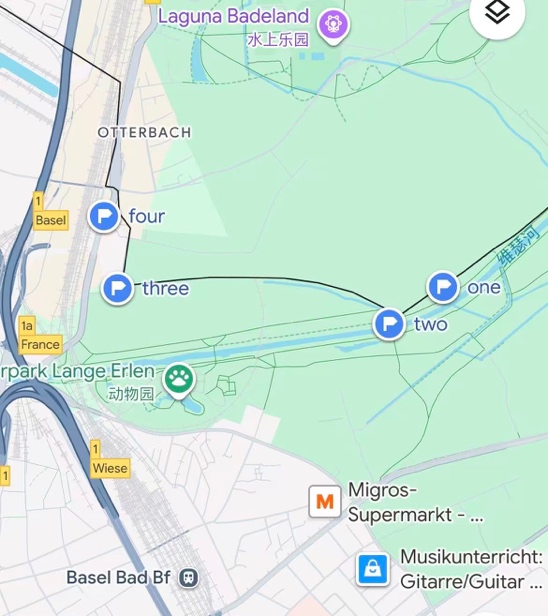
(Figure 1.) Four sites of fieldwork.
I. The Multiple Determinants of Emotion Generation: Materiality, Contingency, and Identity
When we were crossing the border into Germany at site 1, I encountered a woman walking her dog towards Basel. Suddenly, the dog barked at me, which, somehow, made me experience an unprecedented sense of discrimination that made me angry. The reason I depict it as “unprecedented” is that in the past year, almost everyone I met in Switzerland, Germany, and France had been extremely friendly. Clearly, this dog has no awareness of borders or national boundaries. Interestingly, I once experienced a sudden attack from a larger dog at Zollstraße in Weil am Rhein near the border tram stop. However, I didn’t feel any discrimination there. Why and how did this emotion arise?
I believe this emotion stems from the multiple determinants, such as border materiality, contingency, and my own identities.
As an Asian, do I unconsciously carry the presupposition of encountering discrimination when I’m at a sensitive site like the Swiss-German border? Is there some causal relationship between border and discrimination? Brian Massumi reinterprets Deleuze’s concept of intensity. He argues that space should not be understood as a pre-established form or container but as a field constituted by intensities. Within this field, multiple potential affective connections coexist and interact with one another; they are not structurally predetermined, but are actualized in concrete events with varying probabilities. (Massumi 2002)
Border spaces are more prone to be sites where discrimination is generated for diverse ethnic and national populations gathered there. However, the intensity of a site lies not in directly causing a particular outcome such as discrimination, but in increasing the probability of certain interpretations. It is a dispositional structure rather than a deterministic causal mechanism.
For example, the initial fear I experienced at site 3, the Basel prison on the border, almost disappeared after repeated exposure; the same was true of my fearful experience at site 4, the border checkpoint. Whether this dispositional structure is activated or reinforced by an individual is closely related to his identity, border awareness, task status, and contingency.
During my fieldwork, two identities continuously interpellated me. One identity is that I am a third-country citizen in the context of Switzerland and Europe. It inherently carries a quality of being marginalised. Even though I have experienced almost no obvious discrimination or exclusion, this identity still fostered a sense of self-marginalisation. Another is the identity of a “critical urbanism student”, which required me to continuously engage in critical thinking in my fieldwork, identifying situations through giving concepts.
Under this dual identity, when I am acutely aware of my location in a border region, this sense of spatial separation causes me to escalate and translate any conflict—even interspecies conflict—into national or ethnic antagonism, giving rise to a particular emotion that I identify as “discrimination”. Simultaneously, the task-oriented nature of fieldwork further facilitated the recording and reinforcement of this sense of discrimination. Thus, I would still feel the same way even if the purely formal attack with no content was exerted by another small animal. Therefore, emotions or feelings do not necessarily originate from the attacking object, nor are they entirely dependent on the space in which we are located, but rather on how an individual perceives and handles conflicts occurring in a particular or sensitive region. As Alaa Dia mentioned, work on storytelling maps shows how participants often annotate spaces with subjective meanings. (Dia 2025; Musiol 2020) This properly explains why my two Swiss group members did not experience any emotional reaction in this scenario. As Sletto argues that boundaries in participatory maps are best seen as sites of discursive struggle and shifting symbolic significance rather than fixed spatial markers. (Sletto 2009; Dia 2025)
How does my Asian identity influence my perception of conflict? How does my fieldwork task shape my way of feeling? How does my critical thinking training intervene in the interpretation of emotions? How did I translate an interspecies encounter into a “mappable moment”? A series of multiple determinants made it impossible for me to experience the environment from a so-called neutral perspective and may even have made the triggering of emotions itself a performance. The significance of this performance lies in the fact that only when I place myself in a vulnerable position can I reasonably and legitimately obtain protection.
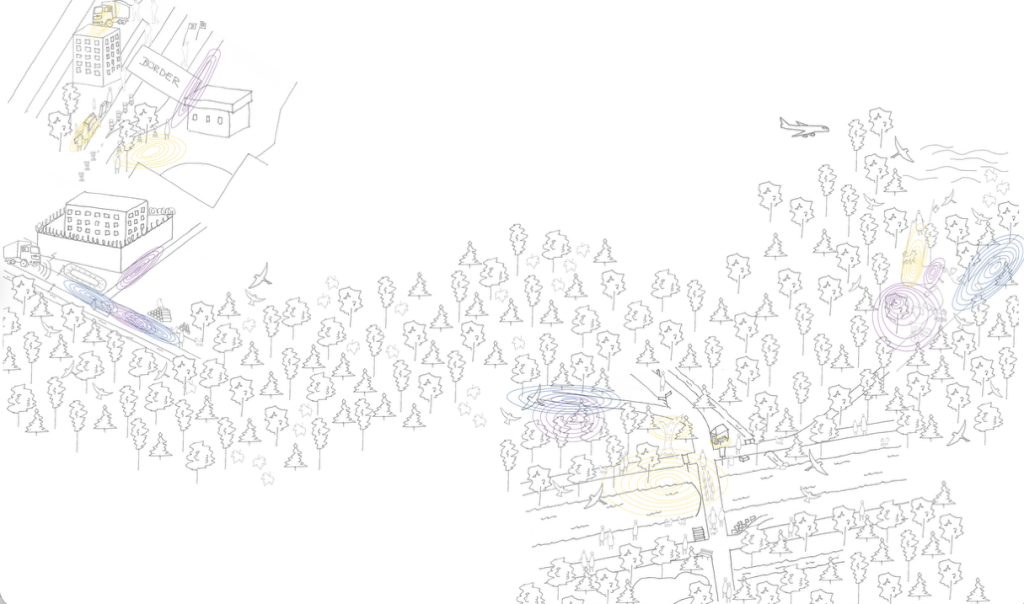
(Figure 2.) Individual emotion mapping of Yichen.
These multiple determinants also explain another phenomenon: there exists no commonality between the three of us emotionally. Especially at site 2, we encountered a large group of elementary school students during the recording process. In this open space and amidst the sound of flowing water, I experienced vitality and ease, while Filippo felt angry. Did this anger necessarily stem from these students?
This raises a new question: when we record emotions, are we recording the emotions generated by the interaction between the observer and the border environment or the emotional interaction between a chance event at the border and the observer? This distinction is directly reflected in our final emotion map. Although I spent considerable time discussing the experience of discrimination earlier, I still considered it not a part of the border surroundings but a chance event that did not include it in my emotion map; conversely, Filippo recorded the anger caused by the schoolchild in his map.
This is related to how we define the “border environment” and “contingency”. In my initial mapping perspective, the schoolchild and the dog walker were considered chance events occurring at the border, not part of the border surroundings, based solely on my belief that they were not stable, persistent elements existing at the border. It contains a presupposition that there exists an essence of the border environment. However, to some extent, checkpoints, borderlines, and the border surroundings are all chance events. Once I regard contingency as a razor to define the environment, after removing chance events, the border environment might be completely empty, even including my own observer position.
This fieldwork by an Asian Critical Urbanism is itself a matter of chance. When I try to eliminate chance, I am essentially erasing myself. But for Deleuze, when everything is event, everything is essentially becoming. The event is openness and chance in the present. (Gilles Deleuze 2008) In this sense, the environment may simply be the collection of countless chance occurrences at a particular moment and is constantly in a process of generation.
The consequence of the contingency dominating my observation is that, as my groupmates pointed out, my emotional map was almost entirely covered with joy.
Upon further reflection on this emotional position, I realised that the border as a chance element of the environment had also been eliminated by me. The joy I experienced stemmed solely from reducing different locations to a homogeneous “outdoor space”. I wasn’t expressing joy toward the four specific observation sites but rather joy at the “outdoor” itself.
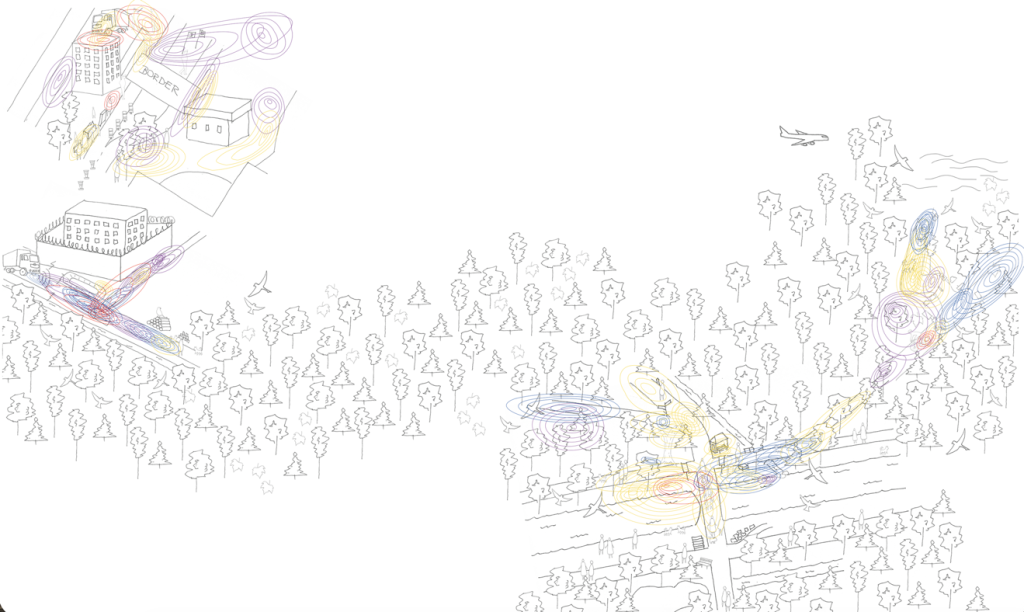
(Figure 3.) Mixed emotion mapping of all group members.
II. The Limitations of Emotion Mapping
At site 4, the border checkpoint, the joy I recorded didn’t come from naturalizing the site but from the success of crossing the border. This emotion wasn’t triggered by the materiality of the space but by a diachronic result that was closely related to my direction of movement.
Every time I travel from Basel to Germany, my tension and anxiety intensify as I approach the checkpoint. These feelings are closely related to Agamben’s discourse on the “state of exception”. Here what is outside is included not simply by means of an interdiction or an internment, but rather by means of the suspension of the juridical order’s validity. (Agamben 1998) Even though I haven’t violated any laws or regulations, I still fear becoming the exception and being deported.
Even in 2025, after countless trips between the two countries without ever encountering the police, this experience hasn’t brought relief but rather exacerbated the tension. This struggle stems from Foucault’s panopticon. (Foucault 1995) The more I can’t pinpoint the concrete subject of surveillance, the more I experience a directionless gaze. ‘Directionless’ means that countless potential viewpoints are staring at me, while I can’t figure out their exact location. For me, this is an extreme form of surveillance.
Undoubtedly, architecture and the environment also participate in constructing this surveillance. The border checkpoint acts as a massive viewpoint that gazes at me relentlessly. Consequently, I never dared to look through the glass when passing, for the subject’s counter-gaze upon the object is intolerable from the object’s perspective—it constitutes a provocation against existing power relations. However, after accumulating countless experiences of unimpeded passage, I constantly reminded myself: perhaps it was all just my imagination. Ease (self-denial) and tension (being gazed upon) were always in a constant state of confrontation.
This tension and unease peaked as I approached the border checkpoint, and once I successfully entered another country, the emotion instantly transformed into pleasure. This pleasure was the true source of the joy I experienced at site 4. When I returned the way I came, this emotional confrontation reappeared. Only the spatial location of the emotional movement had reversed. Emotionally, both the Swiss and German borders were abstracted by me as “the unease of leaving” and “the joy of successful entry”. Therefore, my joy is the result of my movement within space, not an emotion bestowed by space itself.
If I didn’t intend to enter Germany but merely remained in the border region of Basel, I wouldn’t feel tense or uneasy and might even still experience the joy of being outdoors. However, this joy is completely different in ontological dimension and intensity from the joy I experienced upon successfully entering Basel. Even as a form of anti-mapping practice, emotion mapping actually erases their inherent differences by symbolising these two heterogeneous joys in the same colour, yellow. In this sense, this uniform yellow imposed what Laura Kurgan called the tyranny of orientation.(Kurgan 2013) The representational symbols in maps erase the possibility of disoriented discovery. Furthermore, existing emotion mapping logic fails to express that the joy of site 4 is generated by diachronic spatial movement, mistakenly interpreting it as being caused by the materiality of the space itself.
The crucial cause of these problems lies in the fact that, at the outset of planning the emotion mapping scheme, we incorrectly presupposed the source of the emotion, limiting it to be the product of space, thereby reinforcing a synchronic perspective. When the emotion originates from diachronic spatial movement, the methodological limitations of emotion mapping are revealed.
Conclusion
This article is a summary and self-criticism of the practice of emotion mapping. Based on the aforementioned analysis, my basic conclusion is that the mapper is not a neutral observer but one who carries specific identities, historical positions, and emotional structures. Therefore, emotion mapping is not necessarily “reproducing” an objectively existing “emotional space”, but more likely producing or performing a specific spatial-emotional relationship. Furthermore, to some extent, the emotion of a space does not originate from the concrete space itself but from the diachronic flow of a subject with a specific identity within that space. This discovery exposes the inherent flaws in our preset synchronic emotion mapping logic.
Finally, although this cartographic practice exposed many issues, I still believe it was a meaningful attempt. As Linda Quiquivix noted, counter-maps might be beginnings toward a more collective mode of social organization.(Quiquivix 2014)
Bibliography:
Agamben, Giorgio. 1998. Sovereign Power and Bare Life. Homo Sacer 1. Stanford, Calif: Stanford University Press.
Dia, Alaa. 2025. ‘Counter-Mapping Borderscapes: Unveiling Hidden Spatial Narratives | Ellipses […] Journal for Creative Research’.
Foucault, Michel. 1995. Discipline and Punish: The Birth of the Prison. Second Vintage Books edition. Translated by Alan Sheridan. New York, NY: Vintage Books, a division of Random House, Inc.
Gilles Deleuze: Key Concepts. 2008. Repr. With Charles J. Stivale. Montreal: McGill-Queen’s University Press.
Kurgan, Laura. 2013. Close up at a Distance: Mapping, Technology, and Politics. New York: Zone Books.
Massumi, Brian. 2002. Parables for the Virtual: Movement, Affect, Sensation. Post-Contemporary Interventions. Durham, NC: Duke University Press.
Musiol, Hanna. 2020. ‘Cartographic Storytelling, Migration, and Reception Environments’. Environment Space Place 12 (December): 1–30.
Quiquivix, Linda. 2014. ‘Art of War, Art of Resistance: Palestinian Counter-Cartography on Google Earth’. Annals of the Association of American Geographers 104 (3): 444–59.
Sletto, Bjørn. 2009. ‘`Indigenous People Don’t Have Boundaries’: Reborderings, Fire Management, and Productions of Authenticities in Indigenous Landscapes’. Cultural Geographies 16 (2): 253–77.